
Welcome to part 3 of our massive How to Evaluate an Online Arbitrage Product to Sell on Amazon.
To assist navigating this article, here is a table of contents for your convenience:
Table of Contents (Part 3)
Estimating ROI and Profit Potential for an Online Arbitrage Lead
Up until this point, we’ve covered the following in this post:
-
How to identify if a product has potential restrictions
-
How to identify the category, sales rank, and velocity of sales per month using third-party tools
-
How to analyze Keepa graphs to check the price, sales, competition, buy-box, and velocity trends
If a lead passes the parameters in all of the above sections, then the next logical step is to analyze actual profit and ROI potential. If there isn’t any return on investment or profit, then there isn’t any point in further analyzing the lead.
It’s entirely normal to estimate profit and ROI potential before any of the steps above. After all, if there is no money to be made, there is no point in checking restrictions and other metrics. The reason that we analyze later in the process is because of the constant fluctuation of price and sales velocity. Because these metrics consistently change, we can identify certain trends in the metrics that allow us to predict whether a product will have profit and ROI potential in the future, and not just in the current moment. If we go straight to checking the current profit potential without checking the metric trends, a few things can happen:
-
A product may show a current high ROI or profit margin, but on average it may not have good ROI or profit margins at all. This can happen because of current price hikes in the trend.
-
A product may show a current low ROI or profit margin, but on average it may actually have a great ROI and profit margin. This can happen because of current price tanks in the trend.
If you are aware of the history of the product and all of the other trends, you can then make a much more educated guess as to whether or not the product will have higher ROI and profit margins in the future, as opposed to only trusting the current margins.
The Basics of Calculating Profit and ROI for Online Arbitrage Leads
Everyone has a different preference for the margins they want in their business. Without getting into deep accounting, let’s look at the basics of ROI and profit targets. We’ll briefly discuss how the profit formula works, but keep in mind that the tools you will use for sourcing will automatically make these calculations for you.
Nutshell Formula for Determining if an Online Arbitrage Product is Profitable:
Gross Item Profit = Selling Price – (Product Cost + Amazon Fees)
-
Selling Price: The price we sell the item for on the Amazon marketplace
-
Product Cost: The unit cost of the item when purchased from a lead source
-
Amazon Fees: Amazon charges multiple fees for every item sold on their marketplace, especially if the seller is using Amazon FBA services. These include the selling commission fee, order handling fee, pick and pack fees, and weight handling fees. Basically, they take fees for storing and fulfilling your inventory for you, as well as a commission of the actual sales price. You can view more details on their fee structures here.
The profit that a product makes is directly dependent on the sale price, product cost, and amazon fees, but there are also other factors that can eat into your margin that aren’t directly included in the gross profit formula.
Quick Sourcing Tips to Avoid Surprising or Excess Fees
It's impossible to dissect all the different types of fees that you may or may not encounter, but here are a few things to keep in mind when sourcing products:
-
The heavier and larger the item, the more it costs to ship items from a prep company to Amazon warehouses. Generally, when you are creating shipments to Amazon warehouses, it will cost you about 50 cents per pound of product. However, Amazon adds on extra fees for heavy or oversized items.
-
The largest ‘normal’ box size Amazon allows for shipment to their warehouses is 18” x 18” x 24”. The larger the product, the fewer products can fit in a box, and the shipping costs usually increase closer to $1.00 / lb. If your products are too large to fit in the accepted boxes, special arrangements have to be made and fees drastically increase.
-
The lighter and smaller the product, the better.
Aim for 40-50% or More Target ROI and for Online Arbitrage Leads
ROI refers to the percentage of profit compared to the money spent on purchasing a product. Ex: If you spend $5.00 on a product (your cost) and the product sells for $17.50 on Amazon, the difference is $12.50. After Amazon collects fees and commission (let’s say a total of $5.00), you are left with a $7.50 return on the original $5.00 investment you spent. So, you made your $5.00 back, plus $2.50 profit. $2.50 is 50% of the $5.00 you originally spent, so you have a 50% return on your investment.
In general, if you aim for a minimum of 50% ROI on a product, your profit margin will fall in line around 20%. 20% is around the average for gross profit on a reselling business. 40% is the minimum ROI number that we have our sourcing teams and buyers aim for. If you can make 50% ROI on a sale, then your profit is going to naturally fall in line. The higher the ROI you make, the higher your profit margin as well. So, how do you calculate your estimated ROI and Profit potentials?
Calculating Estimated ROI and Profit for Your Online Arbitrage Products
There are several different Amazon FBA calculators you can use to estimate the ROI and profit potential of a lead, but our team uses the scouting tool inside of Inventory Lab. It’s a basic all-in-one solution for accounting, creating shipments, and researching products. It’s great for beginners, especially if you don’t have a bookkeeper who is using a more advanced accounting system like Xero or Wave
Calculating Revenue and Profits Using the General Amazon FBA Calculator:
Click here to access the revenue calculator.
Enter the ASIN for the product you are analyzing and a calculator will pop up. Enter the price you wish to sell for, as well as your cost to ship to Amazon + your cost of product and hit Calculate.
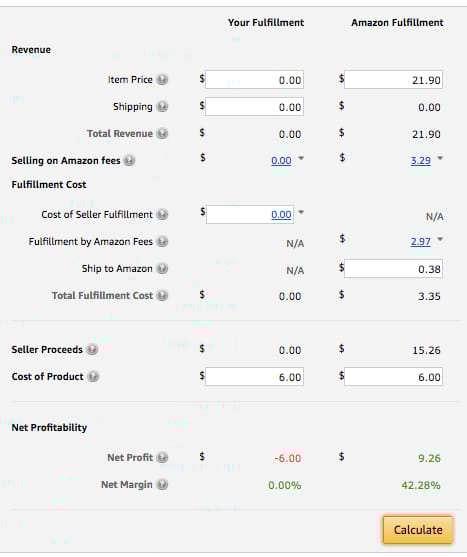
In this example, if the unit cost is $6.00 and you sell the unit for $21.90, the net estimated profit is around $9.26. The fees show about $3.29 for marketplace fees and $3.35 in Amazon FBA fulfillment fees. The amount of money Amazon would return to you for this sale is $15.26, and if you deduct your cost of $6.00, it leaves you with a profit of $9.26. So, you made your $6.00 back + an extra $9.26 profit.
One downside to this calculator is that it doesn’t show the ROI which is what we use to estimate lead potential. But, since we made an extra $9.26 back on top of our $6.00 cost, the ROI is 154.3% ((9.26 / 6.00) x 100) The Net Profit Margin is 42.28%, not to be confused with ROI. Remember, the goal is to aim for a 50% ROI, so getting an ROI of 150% is awesome! The bigger the better.
This calculator has some pains. You have to open that browser and manually type in all the information, and it doesn’t show you what the current sellers on the listing are selling at either. It also doesn’t spit out the ROI. If you wish to learn the ropes, it’s a good option to get familiar with the fee structures. You can also use the Amazon Seller Central App for mobile devices to calculate fees in a similar fashion.
ROI and Profit: How to UseRevSeller As Your Amazon FBA Calculator
We briefly touched on RevSeller earlier when discussing the process of analyzing variations, but it also has a nifty tool for quickly calculating ROI and Profit potential. One of its features is a calculator that is embedded directly in your browser when you view an Amazon listing. It allows you to immediately calculate ROI and Profit potential by entering your buy cost only at the top of the Amazon listing page. It automatically pulls the current buy-box price into the sell price input and calculates the estimated ROI and profit potential.

The $21.90 sale price was auto-generated based on the current buy-box price, and all we had to do was enter the buy-cost of $6.00 to get the estimated Net profit, ROI, and Profit Margin numbers. It also shows you other useful information such as rank, category, weight, dimensions, UPC, and more!
Again, RevSeller isn’t free, but it’s totally worth the $99.99/year if you are serious about creating an Amazon business. You can get $20 off your first year and a 30 day free trial with zero credit card needed by using code REVFBA20 at checkout.
ROI and Profit: How to Use Inventory Lab as Your Amazon FBA Calculator
After our sourcing teams put together the daily lead lists, our buyers re-analyze them using Inventory Lab’s research tool. Inventory Lab also comes with a cool app called Scoutify, but in this example, we are going to look at the traditional web app.
Once in Inventory Lab, navigate to Research > Scout
Enter the ASIN and the screen above will pop up. Like RevSeller, it will automatically pull the buy-box price into the list price box, and all you have to do is enter your unit cost. It will then calculate the ROI and Net Profit, and give you a nice breakdown of fees.
You can also enter an average shipping rate into the Inventory Lab settings (we have .50/lb entered) and it will automatically deduct the inbound shipping fees to the Amazon warehouses from your margins. We highly recommend this because will give you a more accurate estimate of your return, especially if the items are heavy or oversized.
The coolest feature about Inventory Lab’s research calculator is the seller price break down. You can view all the sellers on Amazon and what they are selling for, and it’s separated between merchant sellers and FBA fulfilled sellers. In this example, there aren’t any current Amazon FBA sellers, so it’s pulling the sell price from the lowest merchant fulfilled seller instead.
In summary, there are multiple options for calculating ROI and Profit potential. If you don’t mind the extra work, using Amazon’s calculators might work best for you. But, as you advance and start growing your business, we highly suggest implementing RevSeller for sourcing and variation analysis, and Inventory Lab for secondary research, creating shipments, and managing your books.
Summary: Questions You Should Answer When Evaluating an Online Arbitrage Lead for Profit and Resale Potential
If you have followed all the steps up to this point to analyze an online arbitrage lead, you should be able to answer the following questions:
-
Did you verify the pictures, UPC, and model # to make sure the product you want to resell actually matches the product you are sourcing?
-
Did you check the ASIN to make sure the item isn’t restricted or HAZMAT?
-
Did you check the current and average sales rank and category?
-
Did you analyze the KEEPA charts for price, rank, and competition history and trends?
-
Has the price recently tanked or spiked, or is there evidence there might be a massive price change in the future?
-
How many direct competitors are competing for the buy-box on the listing?
-
Is Amazon selling the item themselves? (Remember, there will be orange shading on the KEEPA graph)
-
How many items per month is the product estimated to sell? (Use JungleScout, Unicorn Smasher, or FBA Toolkit for this.)
-
Did you check the ROI and profit potential? Is the estimated ROI above 50%?
-
Is the item optimal size and weight for shipping?
-
What % of the profit will be absorbed by prep and shipping fees?
-
Are there a high number of positive reviews and ratings?
-
What colors, variations, and sizes are most popular, if applicable?
We hope this article helped you understand how to properly analyze the resale potential and profit margins of an online arbitrage lead. Once you master the metrical evaluation of the lead, it’s time to estimate how much of the lead to buy.
Delivered to your inbox every week.
Need-to-know seller content only. No spam. Unsubscribe at any time.